Archive for the ‘Philosophy’ Category

When setting up to record a band live, I sometimes get such questions/observations as: “So, you just make one recording, pan things left and right, and cut them into individual songs?” Or, “Why does it take you that long to mix the music. Isn’t it just a matter of panning the instruments and voices, and maybe adding a little reverb to make it sound cool?”

From a layperson’s perspective, this may be all that seems to be required. But let me clarify what live mixing typically involves. Then I’ll mention a few things that typically go “above and beyond” and involve more than a typical live mix.

1. Cleaning and arranging the tracks. First of all, for each song, the tracks need to be cleaned and arranged. Usually, this means: 1) that any time a miked instrument or voice is idle, the track is muted, to minimize bleeding into other tracks; 2) that the beginning and end of each track has to be identified, and faders in/out have to be applied; 3) any noise (bumped mics, strange screams from the audience, etc.) is minimized; 4. that tracks for both lead and background vocals are created for each singer.
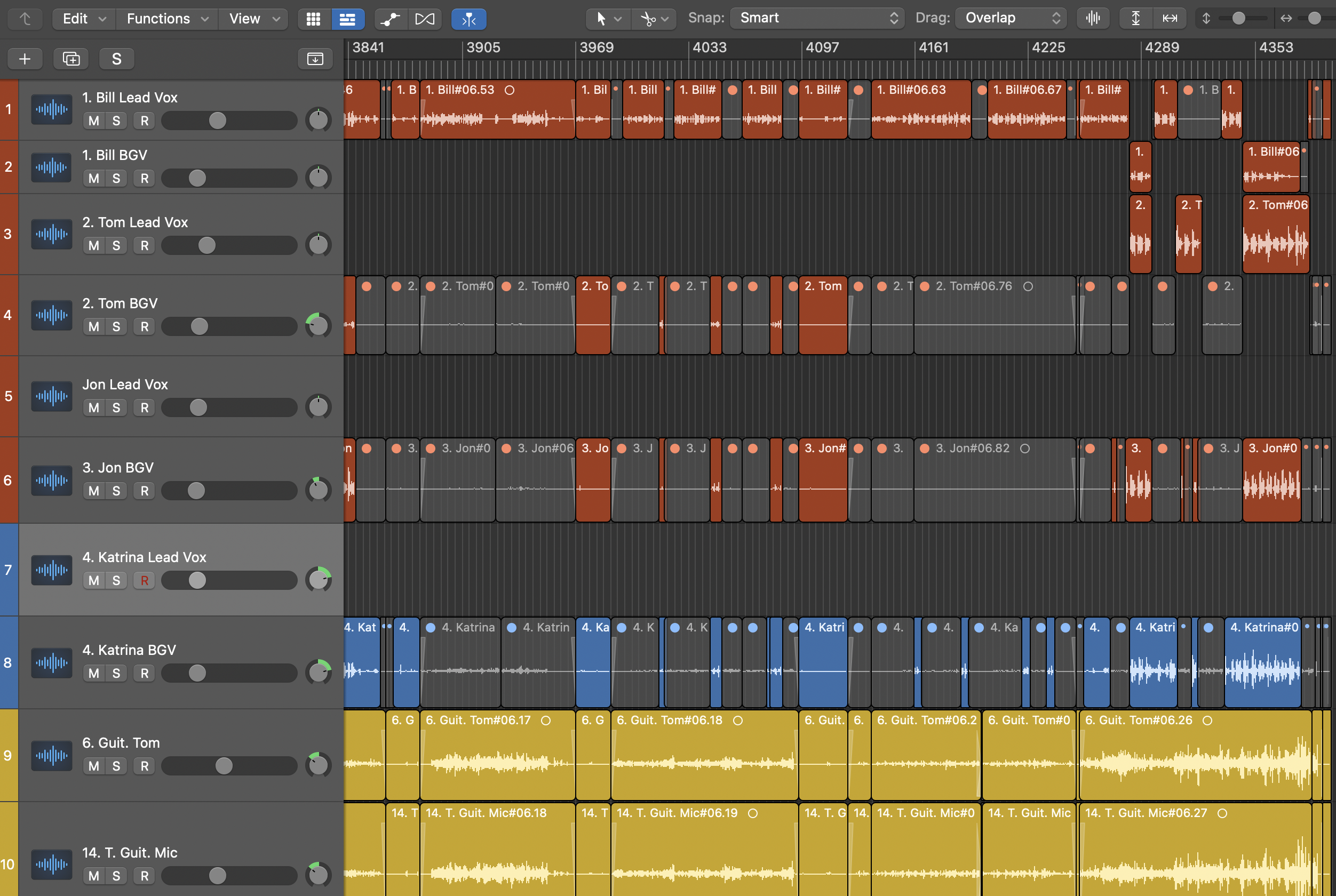
In the photo above the grey areas are muted. The shaded areas at the beginning and end of sections indicate the fade-ins and fade-outs of each song. Notice that both lead and background vocal tracks are present for each singer who does both.

2. Aligning tracks and addressing phase issues. It is important, especially if the drums and back line instruments are a long way from front of stage microphones to nudge those track “forward” ever so slightly to keep stage “delay” under control. This can be done by ear, and by visually aligning the transients between back line tracks and front of stage microphones. It is also crucial to address any out of phase issues between individual drums (kick and snare, snare and hi hat, overheads and snare, etc.) Usually, reversing the polarity of one or two drums will solve these issues.

In the photo above the different directions that these transients are moving indicate a possible phase issue, or the need to nudge a track slightly in one direction or another to match correctly.

3. Getting each voice in shape: This involves adding eq, rolling off the low end (below 350 hz is typical), adding compression as needed, and sometimes a small amount of reverb or delay. This also involves some general panning of voices, though this will vary from song to song depending on who is singing lead. I also use some general pitch correction as needed. And on occasion I will pitch correct a few individual notes.

In the photograph above you can see that I’m rolling off the low end, adding a “vocal rider” (from Waves audio) to bring up low volume sections and tame high volume sections, and compression and imaging using Nectar 4.

The 2 photographs below show a general chromatic pitch correction tool (from Logic) using “chromatic” setting and a moderately fast response, and individual pitch correction using Melodyne.
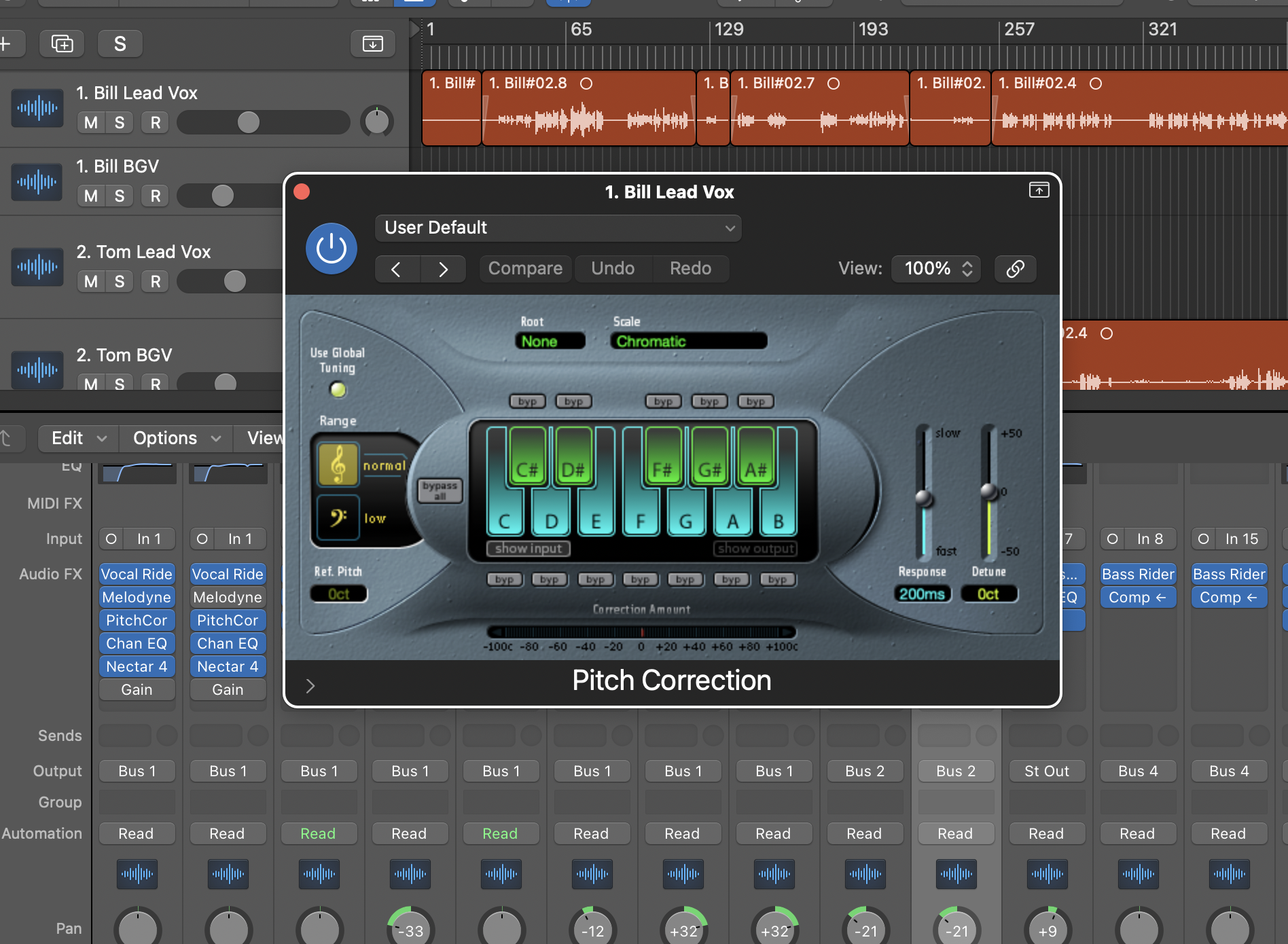
4. Setting up vocal busses: I use a lead vocal buss and a BGV (background vocal) buss. When a singer is singing lead, I buss them through a Lead Singer buss that has a different, more “upfront” and present sound. Those singing background are bussed through buss that is set up for background vocals, with a little vocal doubling, slightly deeper reverb to set them back in the mix a little, etc.

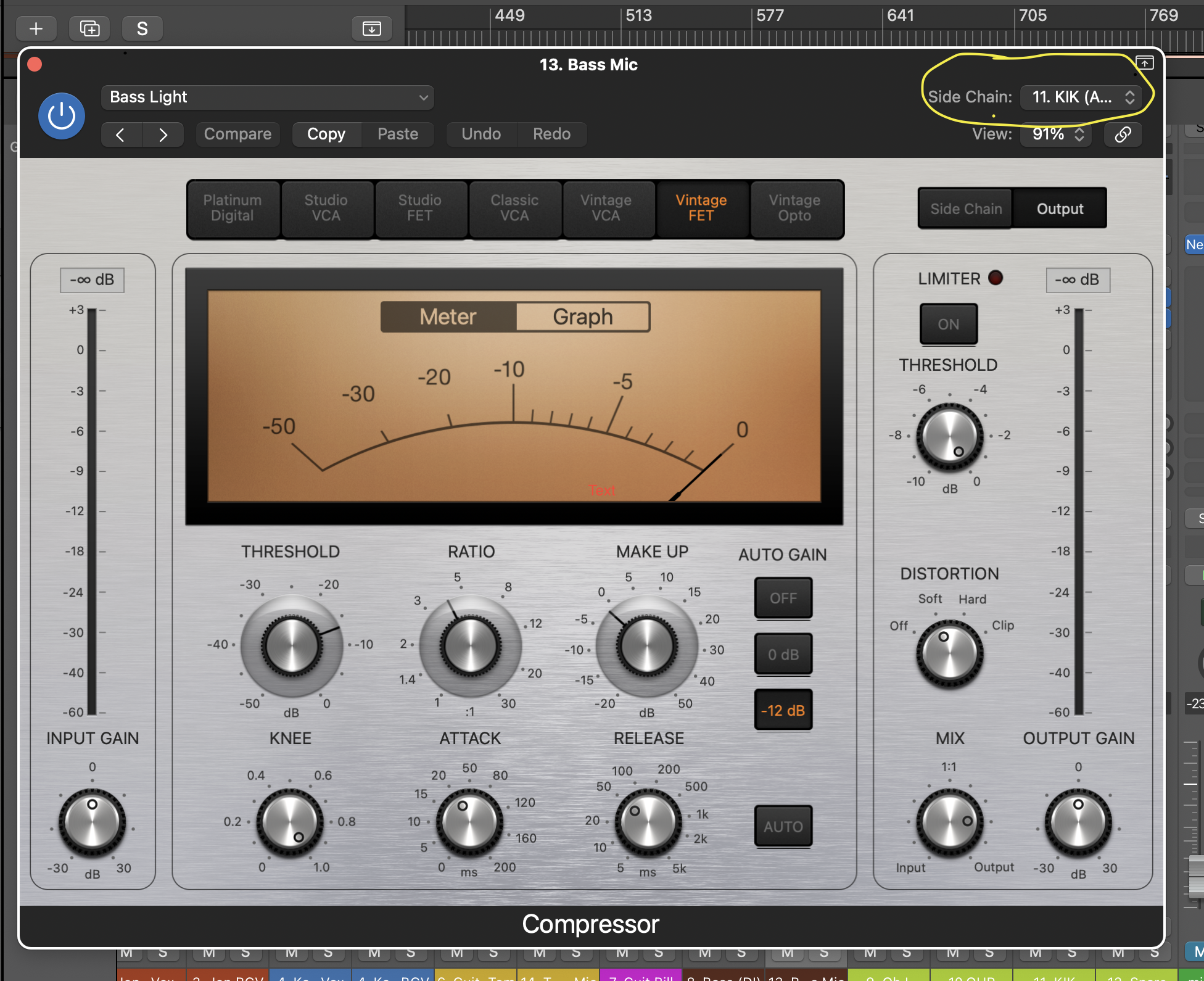
5. Getting drums in shape: This involves adding eq and compression to each drum or drum mic as needed. It also involves “compression-locking” the kick drum to the bass track using a side chain, so that the bass and kick feel “locked” together in the mix. Depending on the quality of drums and the consistency of the drummer, this can take quite a long time. In some instances using “drum replacement” samples will be necessary.

In the photo below, the compressor of the bass microphone is side chained to the Kick which glues them together. Only use 5-6 dbs of audio reduction for this or you’ll get “pumping and breathing” artifacts.
6. Getting the bass in shape: This is a matter of getting the right blend between a DI and microphone so that the sound is what the bass player uses on stage. It also means taking the time to divide the “low end space” of the mix correctly between the kick drum and the bass. Different groups have different sounds in this regard. Some groups have bassists that use bass guitars and amps that grab the territory between 70 and 150 hz. Others have bassists that use lots of “sub-bass” and like their sound to control the space from 60 hz down. This means that the kick will be equalized for the higher sonic territory.

7. Setting up drum busses (see buss photo above). I usually set up a “parallel compression” drum buss which is slammed with compression. As needed, I will send small amounts of the snare and kick through this buss to add punch. I then have a “drum reverb” buss, which will make use of a small amount of reverb, mostly for the snare. I also have a “full kit buss” for all but the kick, set up with compression and eq that helps the kit sit well in the mix. If I use multiple snare or kick mics, I will also run snare and kick busses.

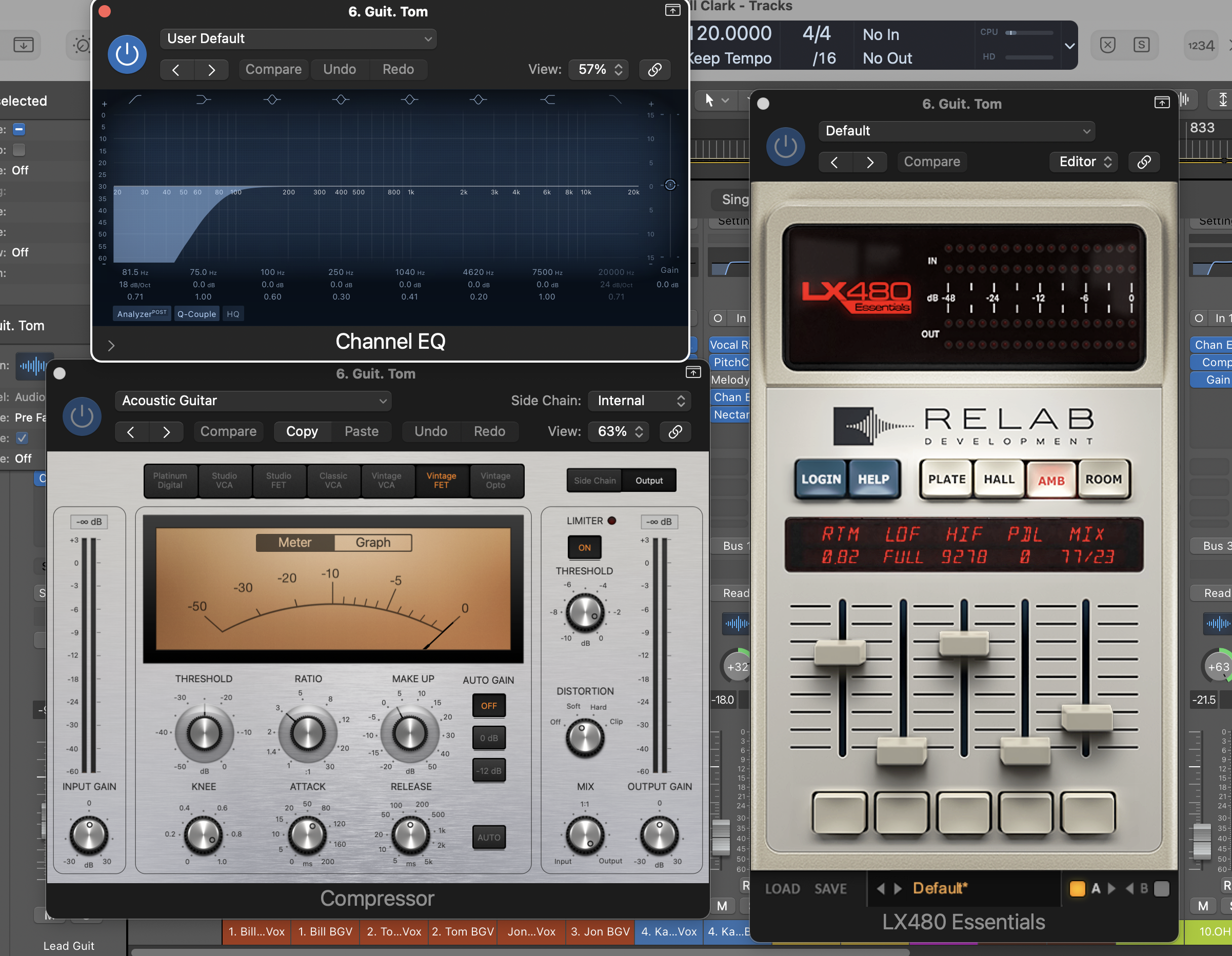
8. Getting the instruments in shape: This varies from instrument to instrument and player to player. For acoustic instrumentalists, this sometimes means rolling off some of the low end (to avoid the accumulation of “low end mud” in the mix). And it can also mean trying to find a clean sound that matches pretty closely what the audience hears, balancing direct boxes and microphones accordingly, and panning in a way that matches the onstage sound. For electric guitarists, the goal is once again to approximate as nearly as possible their onstage sound. For keyboardists, a stereo feed needs to be equalized and panned realistically to match onstage sound.

In the photo below, I’m rolling off the low end on Tom’s acoustic guitar, adding a little soft compression, and some gentle room ambience reverb.
9. Setting up instrument busses (see buss photo above): I usually have “lead guitar” and “rhythm guitar” busses set up, so I can make quick adjustments per song as needed. I’ll also have busses for electric guitars, keyboards, and other instruments, making sure that all instruments with more than one form of capture is mixed and easy to adjust in the mix.

10. Setting up the basic template for each song. Softer songs will require different mixes typically. When a guitarist changes instruments or volume level, decisions have to be made regarding how to bring the instrument up or down in the mix in a way that matches the player’s onstage intentions. Some automation might be required for an instrument when the player has been too erratic with a volume pedal onstage, etc. When multiple singers sing lead on different verses, their voices have to be cut and pasted onto lead or background tracks (see above). Many decisions are required for each song. It is NOT simply a matter of using the previous song’s mix.

In the photo below you can see the automation that was required on Tom’s acoustic guitar on a song where his volume pedal usage seemed to create a few volume issues.

11. Bouncing each song. Once the mix is done, each song must be bounced at a level that allows plenty of head room (at least 6 db) for mastering.

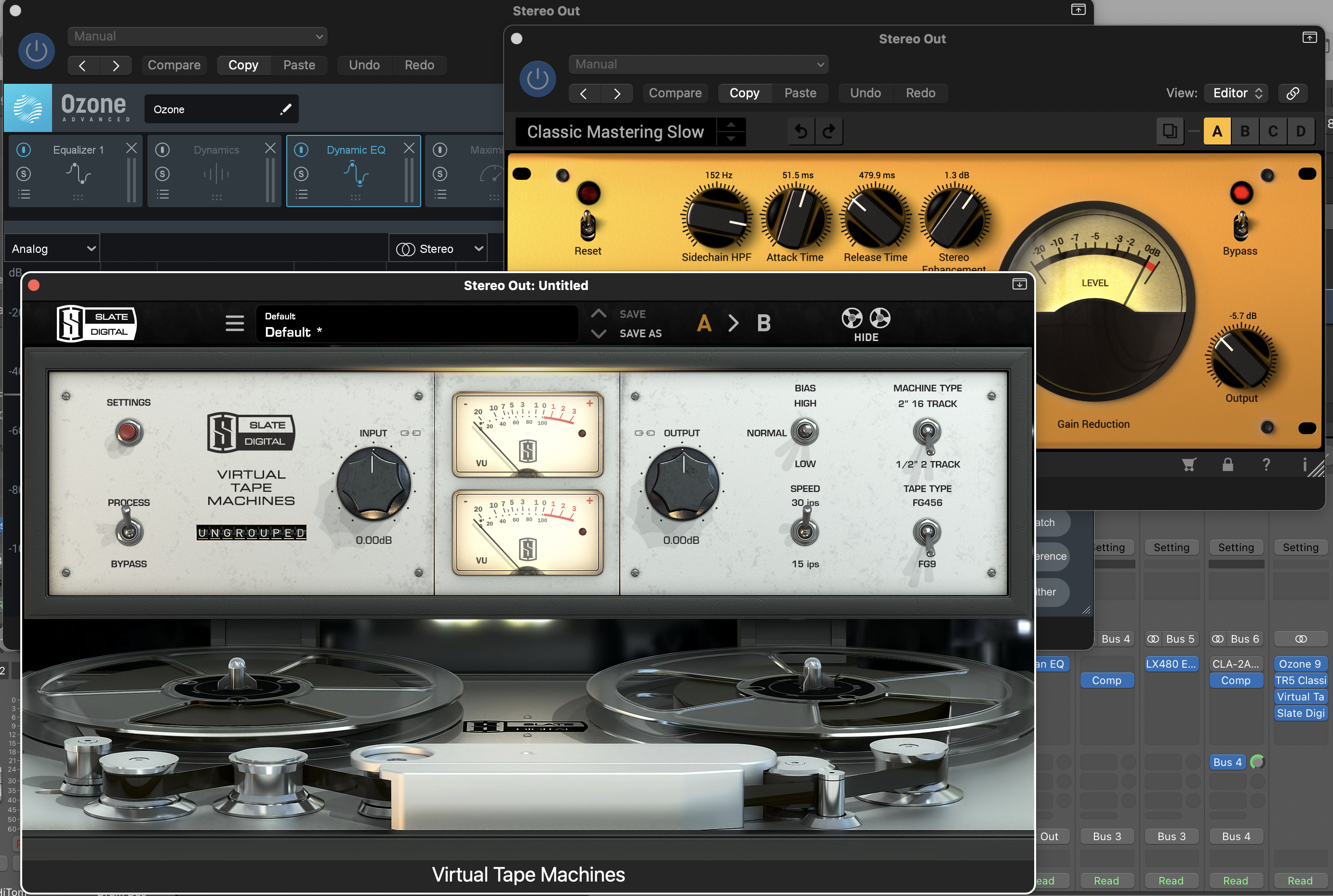
12. Mastering each song. Here you can set up a basic mastering template using eq, imaging, dynamic eq, compression, tape saturation, and a finalizer to bring the song up to appropriate volume for streaming or whatever final target is needed. This will need a little tweaking for each song depending on its volume and style. I usually wind up with an entire mastering “list” for each live performance in one template grid. I also usually add about 2 seconds of silence at the end of each song, making sure that it is faded nicely as well.

In the photo below you can see that I’m using a dynamic eq.(part of Izotope’s mastering suite), tape saturation plugin (from Slate), and a mastering compressor (from IK Multimedia).
Each song occupies a stereo track

in the mastering template.

ABOVE AND BEYOND THE CALL OF DUTY

What I don’t do (but could) when mixing a live performance. Some of these things I’m glad to do for a few choice songs that a band or artist might want to perfect. I assume that a roughly 30 song live gig might only have between 3-10 songs that an artist might want to “dig deeper” on for a CD, or some other presentation. 

  1. Extensive pitch correction.
  2. Fixing the performance. This might mean repairing a lead, bass line, drum hit (errant kick for instance), vocal performance, etc. In some instances this can be accomplished by flying something into a performance from somewhere else (a kick hit or bass note, for instance). In other instances, however, the artist might have to come into the studio and redo a part. This is not always an option if microphone bleed issues are too overwhelming. Fixing a guitar lead, for instance, often can only be done for a few notes and not the entire lead. It’s also possible to make the background vocalists and lead singer enter and release together. This sometimes requires using Izotope RX Rebalance on the vocal tracks to remove most of the music bleeding into vocal mics prior to realignment to avoid adding delay or artifacts to the vocal tracks.
  3. Changing the mix. This might involve adding more reverb, adjusting volume or pan, and so on as per the artist’s taste.

Many bands that play mostly in small to medium sized clubs will have YouTube or blog posts of their music. Often the videos are fine but the audio will be poor. Most computer video programs (think QuickTime, IMovie, etc.) will allow you to strip audio and insert a good recording of your music to sync with your video. Although a good two-track stereo recording can be an improvement, a multi-track recording gives you many more options which, if mixed correctly, can provide a first-rate, natural (not over hyped) listening experience to go with the video.

There are a few things that have helped me get a better-quality multi-track recording over the years. I’ll share some of these below. Then, I’ll give an example of the kind of recording I’m talking about by providing an example of a recording of Louisville band, Palo Verde.

  1. Use the right microphones. Some singers want to use their own microphones. It is important to check ahead of time to see what these microphones are. While some will work well, others will produce significant mixing issues. The same is true for drum mics, etc. Be sure to double check! Super or hyper cardioid mics are best because they work to eliminate noise from other instruments and especially floor monitors (see #2 and #3 below). Remember that when you’re trying to get a natural live sound you don’t need to put a microphone on every drum unless the band normally does so for the house mix. A single overhead (Omni?) microphone, kick, and snare mic will be plenty for many bands and less intrusive.
  2. Tweak monitor placement. While in-ear monitors permit the best recordings, most bands still use floor monitors. These should be placed well behind the microphone’s sound field. This is usually not difficult with singers. It is most difficult when a drummer uses a floor monitor, and it faces upward toward the overhead microphones. This means that the monitor mix will intrude on the drum’s overhead mix and render the overheads virtually useless. I usually bring along a spot monitor that I can place near the drummer, facing away from the overhead microphones.
  3. Control monitor mixes if possible. If the band is in a space with walls on either side and a wall in back, it will help if the front of house mixing engineer can run individual monitor mixes to each musician on stage, providing only the minimum of what they need. Full house monitor mixes at high volume can bleed into all of the stage microphones and wind up competing with your overall mix in a lot of ways (especially by creating out-of- phase issues) so keeping them as modest and targeted as possible will help later down the line. If band members are used to in-ear monitors this is best, of course!
  4. See if you can position musicians with the vocal stereo field in mind. If a band has three-part harmonies and those singers all stand at the front of the stage, it can help if these singers are not bunched up on one side. You will likely want to mix them to left and right, so have them stand on stage left/right if possible. This is helpful also because of the drum-bleed that comes through on the vocal mics. When mixing, the stereo field for the drums can be disoriented or out of phase if you are mixing a singer to the opposite side of the mix from where they stood on stage. Most musicians will honor this request, knowing its only for one night, if it is a huge change.
  5. Don’t fret the room microphone. If you use a room microphone for small to medium size club gigs, you’ll only use it for applause and room noise before and after songs. Otherwise, you’ll hear table conversations, etc. in the mix.
  6. Assess (and use) direct inputs for acoustic instruments. Most artists use direct inputs from pickups for guitars, mandolins, harmonicas, etc. these days. Some are excellent. Others are not so good. Use them no matter what the quality. Why? Because they are what the band “sounds like” and your job is to get that sound. That said, in some cases, you might want to stick a directional mic in front of an instrument, just to provide the option later of improving the sound. And remember, a good sounding direct input eliminates microphone bleed!
  7. The more you can control the better. In order to have maximum control over the quality of recording I prefer getting a direct feed into my own preamps and converters. Although many affordable mixers will now do multitrack recordings (Midas Mr18, Mackie Onyx, etc.) I prefer to use better quality preamps and digital to analog converters. For that I use a passive stage box that is a splitter, with one cable running to the bands mixer and the other running directly into my preamps and converters. This allows the band’s engineer to do his/her thing unimpeded while I do mine. When using a passive splitter, it is a good idea to carry along a few inline phantom power supplies and several good DI boxes to help with any ground lift issues. If you have the money and want to be sure you have the tools to get a good isolated sound and avoid compatibility issues with the house mixer you can avoid a passive splitter and get a few transformer isolated splitters such as the ART S8 and the cables to get from the front of house to the splitters and to your recording rig. I like my passive splitter because it has the cables built in and is easier to set up and haul. My basic converters and preamps are the Focusrite Clarett + series. I love the clarity and detail of the converters and the preamps sound great for just about everything. If I need other preamps I can bring them along.
  8. Mix to reproduce the live sound! The number one rule for mixing comes down to avoiding PD (plugin disease). When you have good tracks, it is tempting to add lots of effects (reverbs, delays, compression, etc.) that were NOT in use live. I see my job as reproducing a true to life recording that mirrors what the audience was actually hearing. When someone who attended the gig hears the recording as the audio for a YouTube they can say, “Wow, that’s just how the band actually sounded!”  

I recently had a chance to record Louisville’s Palo Verde at an outdoor venue called Bud’s Tavern. The recording was not made for video purposes, so live video is not available here. Here’s an audio track from that event, however, to provide a feel for the kind straight-forward enhanced “live sound” I’m talking about. You’ll want to listen on headphones or good speakers to appreciate the difference between this sound and a simple iPhone or two-track stereo recording.

When we moved to Louisville from Nashville I went from a larger space to a smaller setup. Basically I now have a control room shared with a small isolation booth for vocals, acoustic instruments, etc. and a second room next door for tracking drums, and other loud instruments. There are also several small rooms and closets nearby where amplifiers can be isolated when groups want to track live. The setup is small, but still large enough to do live work if needed. The floor is on a slab, and the windows are treated with “Indows” that improve room isolation a lot.

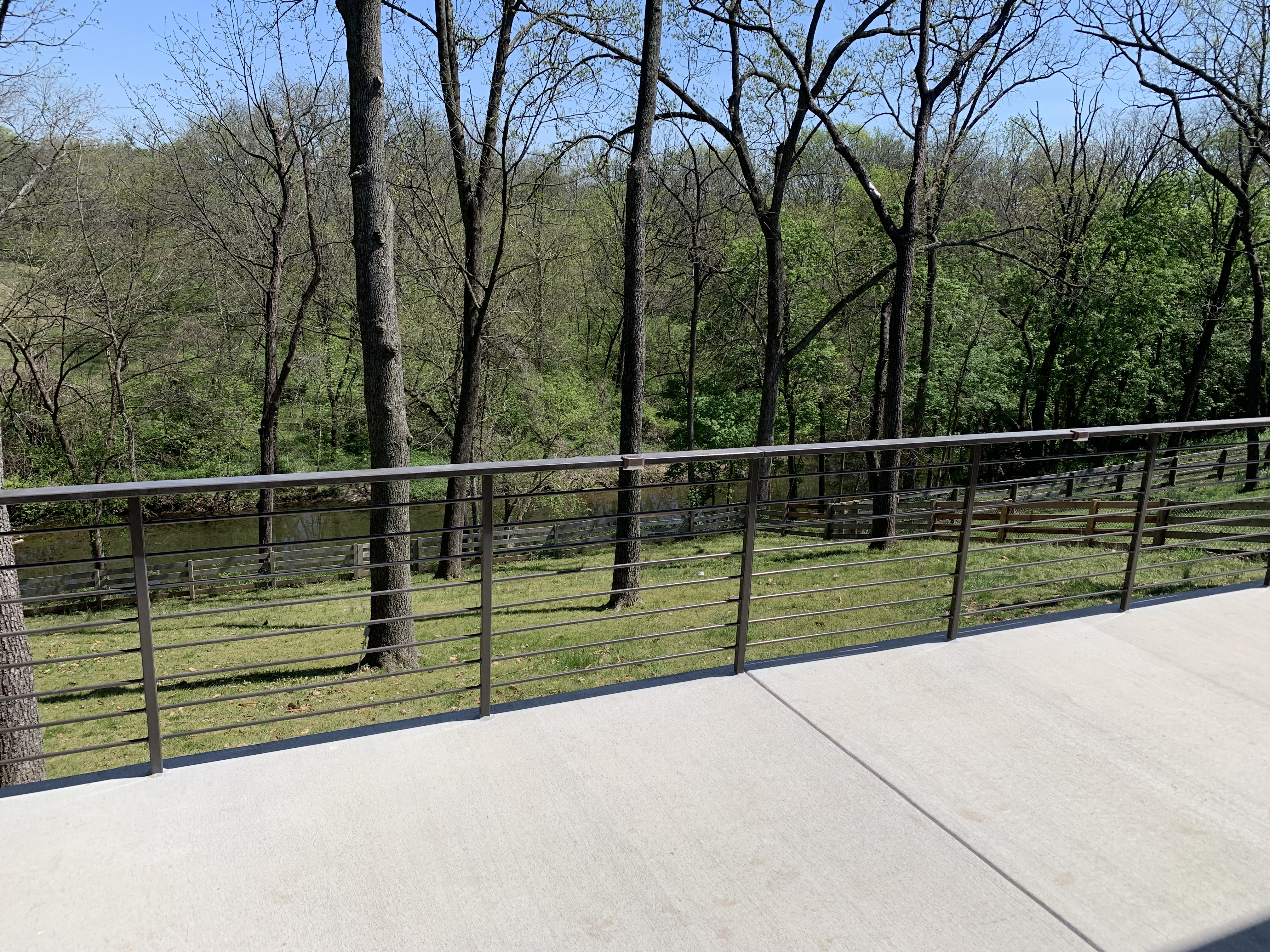
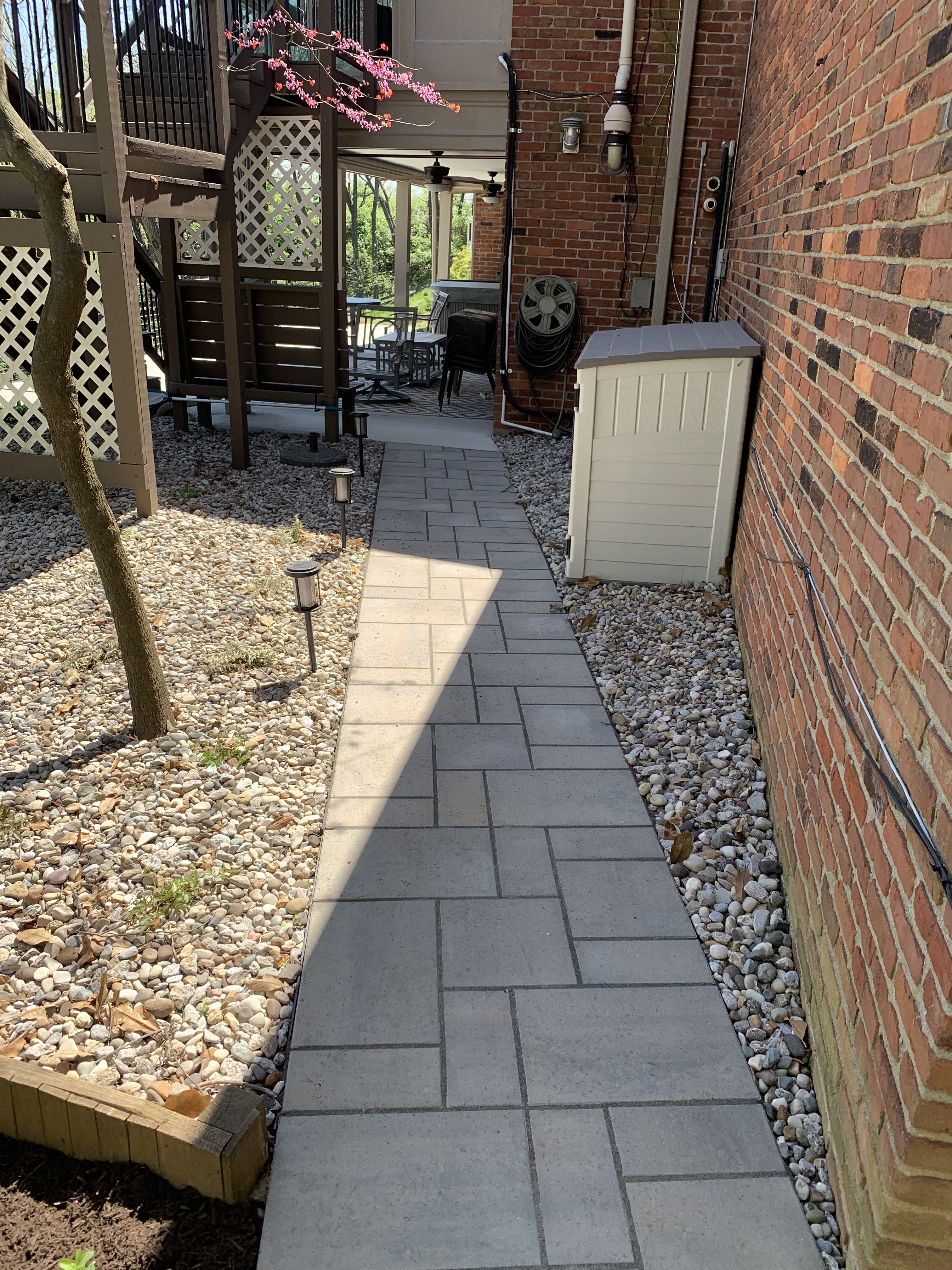
The studio is in a walkout basement in our home that overlooks Beargrass Creek. Access to the studio is via stone steps that run from the driveway alongside the house to a patio where musicians can gather or just hang out when not recording. The patio has a lovely view of the Creek

The door from the patio leads into a mi-size room where furniture can be easily moved around to set up drums, or other louder instruments for tracking. The door at the end of this room leads directly into the control room. The screen can be used as needed to see others in the control room and vice versa.

Here is a view of the control room / isolation booth taken from the large window on the creek side of the room. You can see that a large closet has been converted into a small iso-booth for vocals, etc.

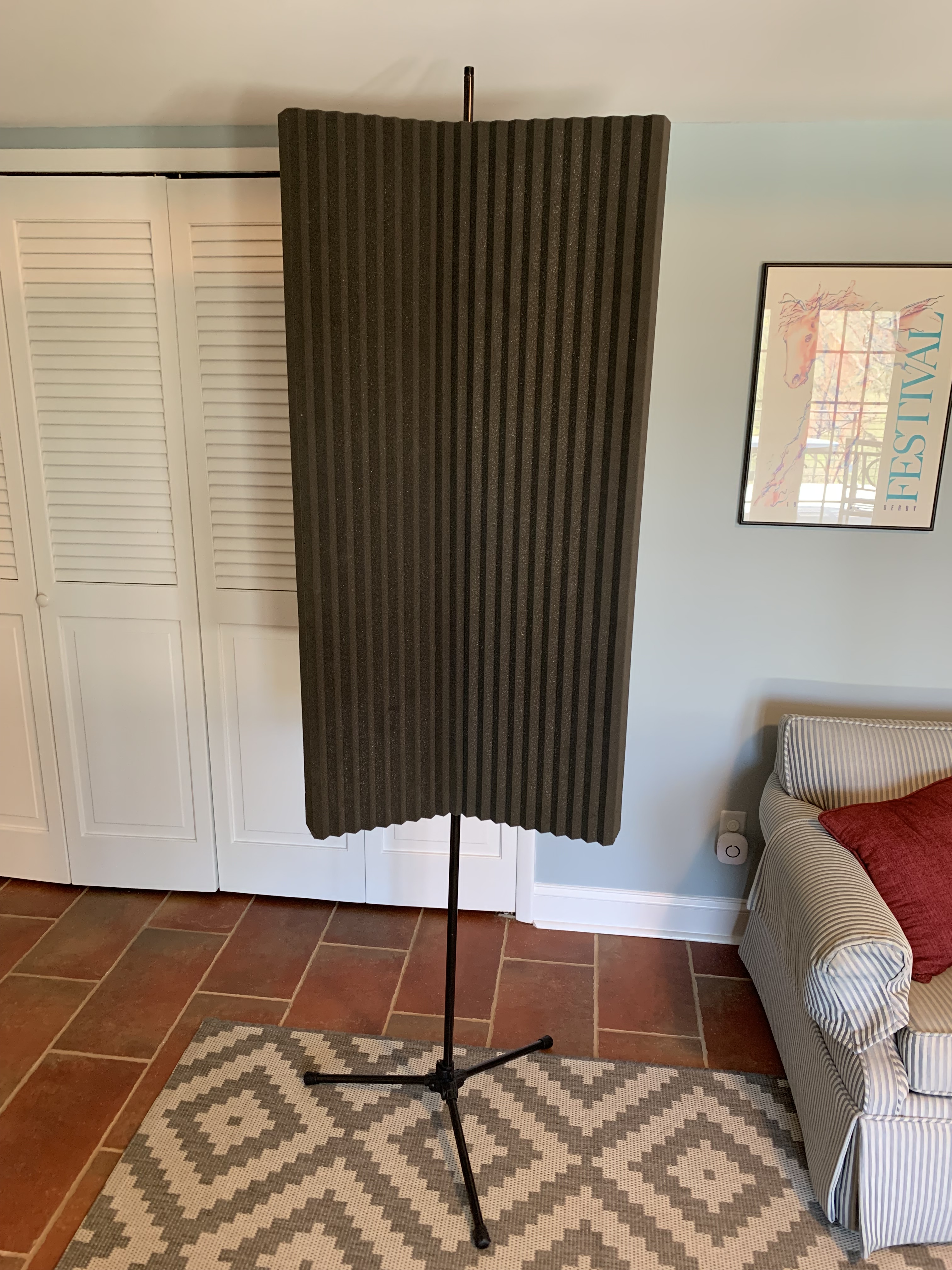
When isolation is needed, or corners need to be taken out of the recording, I now use a lot of these moveable Auralex gobos. They are amazing and work for just about every application possible.

These can be set up around or in the isolation booth if more or less isolation is needed, depending on the voice or instrument and the frequencies you want to enhance or squash.

From the isolation booth toward the window, here is the view, and the scene out the window. A great place to work on music!

All in all, it’s a great place to hang out and record music! I’ve settled in now and the vibe and the sounds are absolutely first rate.

So, as a project studio, owned by someone who records, mixes, and masters “on the side,” I’m often approached by artists who are looking for a deal – which sometimes means they expect free service. In many instances, these are friends, or friends of friends, and in some instances they are really good artists – the kind I’d love working with! Or they want to use the studio and/or equipment but without me. Why not?

There is a part of me that would love to oblige good folks and even do what I do free of charge. I love what I do, and I love helping others achieve their musical goals. Early on, as I was “working on my chops” I did a few free projects – which took some of the pressure off and helped. When I listen back to some of those projects, I’m glad I didn’t charge!

As I got better, I found myself 50-75 hours into a project, listening to an artist ask me to “tweak” something (which sometimes would take several hours) and saying to myself: “I’d feel a lot better about this is I were getting paid!” True enough.

The fact is that many artists are unaware of the amount of time it takes, beyond tracking time, to get a project mixed and finished – even if it’s just vocals and guitar, or a few tracks of audio. Tracks have to be cleaned (gated or “stripped” of noise between clips of audio), de-essed, de-breathed (fixing loud breaths), equalized, sometimes compressed, automated as needed (louder in some spots, softer in others), run to busses, etc. etc. And even if a song is recorded in series with nothing changed, all of this has to be done differently for each song. In other words, a separate file has to be created for each song – and all of these steps done for each song. All of this adds up to TIME.

So about 20 years ago I started charging for my services. In my humble opinion, I’m still “a steal” if you compare my work to comparable work. And at this time I mostly charge by the project, rather than by the hour, which allows me to be the laid back guy that I like to be in the studio – and not to worry when I’m a little slower than some (perfectionist that I am).

Image


Here’s my simple philosophy for keeping expenses down: CONTROL YOUR GEAR LUST!

The marketing gurus are after you! And they are always trying to sell you something you probably don’t need. To record with professional quality, however, you will need a few more items and a few better items than you need for just knocking around with a few garage quality demos. Here’s the recording/tracking chain:

1. Computer. You need a good computer. Two drives: one for your DAW software (Logic, Pro Tools, Cubase, etc.) and the other for your tracks. I’ll have more to say on this another time.

2. DA Converters. You need HIGH QUALITY analog to digital converters. This is one place not to scrimp! The biggest different in your sound happens here – with converters (and digital clock). I use the Apogee AD16x (I sometimes need 16 simultaneous tracks for live tracking) – now replaced by their Symphony system. In order to get the least possible latency, I use the Apogee Thunderbridge and X-symphony card in order to be able to use the thunderbolt in/out on my computer. Get something comparable (Lynx, or UA Apollo). You won’t regret it.

3. Preamps. Next in the food chain are your preamps. Here, the marketers go wild. Since preamps add color and texture to the sound on the way in, helping with the often brittle quality of digital recording, you’ll be tempted to get all kinds of preamps. What you NEED, however, is at least one really good clean or transparent preamp, and at least one more colored preamp (tube or heavy transformer based). You might also get two or three “channel strips”. A channel strip includes a good preamp, a good equalizer, and a good compressor/limiter. The ability to bypass the equalizer and/or compressor/limiter is an important feature. You won’t always want these in the chain.

For clean/transparent pre amplification, I like the True Precision preamps. I bought the True Precision 8, which includes 8 transformerless channels, since I sometimes record bands. It gives me 8 great channels for a drum kit, for instance, and at a good price point. Other great transparent preamps are Grace preamps, but they tend to be a little pricier per unit.

For a more colored transformer based sound I recommend a few channels of API channels or similar. I have the Warm Audio WA-412 which gives me four great channels at a price point well below API prices.

A very nice, inexpensive tube pair of tube preamps, if you can find them, are the Peavey VM-P-2s. The Warm Audio WA2-MPX is also a great choice.

On the channel strip side, you might get a non-transformer strip, a good transformer-loaded strip, and a good tube strip. For a little tube flavor to warm things up, perhaps the best price for the money for a “money channel” is the Universal Audio LA 610 MKII. I use mine all the time, especially for vocals. Another good workhorse choice is the Avalon VT-737sp. For a good budget minded non-transformer channel strip, think about the Presonus Eureka. I use mine regularly. The preamp is fast and transparent, the compressor adequate for most projects, and the eq is very clean. For a transformer-based strip, you can’t do better than the Focusrite ISA 430 MKII. It takes a while to learn (due to its many, many options), but simply sounds fantastic on just about everything – especially bass! I use mine all the time.

4. Hardware compressor/limiters. If you are multi-tracking, you may never need these, but it is a good idea to have a couple on hand to tame transients on the way into the box. You could spend a bundle here, but I wouldn’t. I like the FMR audio RMC1773 “Really Nice” Compressor. Tremendous for the money, and I’ve never had a studio situation – drums, bass, BGVs, etc. where they didn’t do the trick if I needed them to tame a signal.

5. Microphones. Here again, the marketers will want to you spend, spend, spend. What you really need, however, are a few good mics in the following categories:

  • Large Diaphragm cardioid condenser. First, you need a good large diaphragm cardioid condenser microphone for capturing vocals, drum overhead, etc. How good? Well, despite what you might be led to believe, you can get good professional recordings with less than you think. I have come to love quality and versatility of the Neumann TLM 103. This is a very straight forward, quiet, clean microphone with tremendous handling of sound pressure levels (spls). There are lots of other great choices here that won’t break the bank. For vocals I love my Miktek CV4 tube mic. IT works well on most types of voices, male and female. The Mojave MA-200, MikTek C7, Shure KSM44A, or AKG C414XLS will all do the trick for a reasonable price.
  • Stereo Pair – Small Diaphragm Cardioid Condenser. Second, you need a good stereo pair of small diaphragm cardioid condenser microphones for capturing a range of acoustic instruments – mandolin, fiddle, banjo, acoustic guitar, choirs, ensembles, etc. These are also good for cymbals. Many studios make use of the Neumann KM 184 matched pair. I find these to have a tiny bit too much of a high end spike for my taste, which doesn’t make them versatile enough to handle some instruments – like the fiddle. I now use the MikTek C5MP and love them. The high end is not brittle, but smooth and easy to eq. I also like supporting the local economy. These great sounding microphones are made in Nashville.
  • Dynamic Microphones. Third, you need a few workhorse dynamic microphones. These are especially good for recording drums and guitar amps and cabs. I grew up on Shure Sm-57s for these tasks, and I’d strongly recommend looking into the Shure DMK57-52 drum microphone kit. You’ll get three SM57s, and a Beta 52 for kick, along with a nice case and drum mounts. The Beta 52 is a great kick mic, and can also double when you multitrack the bass amp with good results, and does surprisingly well also on double bass. For bass amp miking and for some vocal applications, it is also good to have an Electrovoice EVRE320 on hand. A great mic for the money and a real workhorse.
  • A Ribbon Microphone. Finally, it is a good idea to have one ribbon mic in the closet. Some instruments and vocals just have too much high end bite, and only a ribbon mic can get them under control. And from time to time you’ll want to reach for a mic that will provide that dark vintage vibe. Also, ribbon mics have a figure 8 pattern, which can be helpful in many applications, especially when you want to capture room ambience. Typically these are expensive microphones. Its hard to beat a Royer R-121 for versatility. The AEA R84 is great. If I need one of this quality, I usually head downtown and rent one for the day (about 60 bucks). In my closet, however, I have the very affordable Cascade Fathead II. For most applications, it is more than adequate – great for the squeaking violin or the room mic. And a good guitar amp mic as well. For as often as you’ll probably need a ribbon, this should be enough. I also get great use out of my very affordable Cascade X-15 stereo ribbon mic. I have a very active sounding drum room, and this is a great room mic for stereo miking drums in such a room. It is also lovely on guitar in some applications.

Ok. Granted there are lots of other choices and occasional needs – omnidirectional, tube condenser, etc. And you can keep adding on. The basics, however, are mostly cardioid mics – condenser and dynamic, and the occasional ribbon.

Home recordists usually have room issues. These are often over-stated by product marketers, however. In today’s world, you’ll be doing a lot of close miking, and the room will not present huge issues. Even drum miking can be fairly well controlled in rooms that are not perfect. On the room-prep end, I’d recommend that you grab a closet and turn it into a vocal booth if you can. This will be your main need in terms of room issues. Here’s mine.

Vocal Booth in the Closet

And purchase one of several great new products for controlling room reflections. I use the SE Reflexion Filter when recording lots of instruments, and for some vocal applications – a first rate product. The Auralex ProMAX is also great and very versatile. Two of these will be all you’ll need to control most room issues.

That’s it for gear in the recording/tracking chain. You don’t need more than this to get professional quality recording going at home.

I’ll blog another time about studio monitoring equipment and recording software and plugins to consider. Again, the philosophy is, and will be, the same – Control Your Gear Lust!

As I mentioned in the “About” page, I have four reasons for posting this blog.

First, in the section entitled Recent Projects, to (gently) advertise my project studio. I try to record 8-10 projects annually, and would be glad to discuss whether what I do is appropriate for your project. From time to time, therefore, I’ll post links to music recorded in the studio so that you can get an idea of what I can do.

Second, in the section entitled Philosophy, to share my philosophy of recording.

Third, in the section entitled Tricks of the Trade, to share ideas that I have about improving both the workflow and quality of project studio recordings.

Fourth, in the section entitled Gear, to discuss gear I have used or found useful in studio production.

For over thirty years now I’ve been recording and mixing music. No, it’s not my “day job.” I teach (now retired) at Vanderbilt Divinity School. I write books on all kinds of topics. I’ve also been known to blog on a range of topics – in particular preaching and worship, and popular religion. My passion for recording music intersects with my other interests – which focus on the philosophy and impact of sound and words in the public arena.

My life in recording began in my teenage and college age years, in Birmingham, Alabama. I worked for a film company (Metcalf Productions), writing soundtracks (mostly music) for commercial films and television spots. I hung around the studio as much as I could, learning the basics of microphone placement, mixing and editing.

Studio Engineering was not how I wanted to make a living. I had other interests oriented toward scholarship and teaching. But music performance and recording remained my primary hobbies – and soon became a bit more than that, as computers began to make recording more accessible for hobbyists.

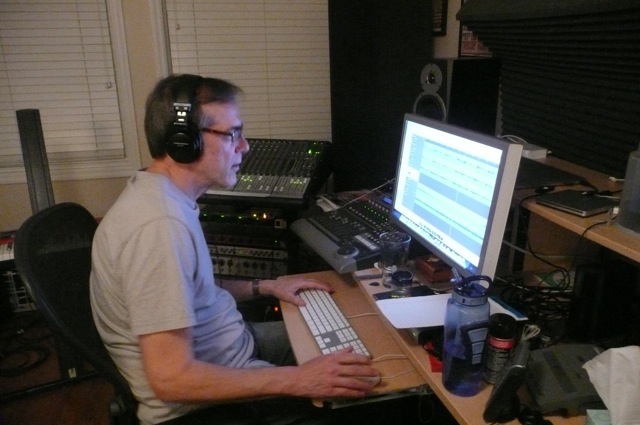
In the Control Room

With the advent of computer-based digital sequencing in the 80’s and then the full-blown marketing of digital audio workstations (DAWs) in the 90’s, home recording leapt to new levels, and became more accessible to hobbyists. I began editing on the German based software Emagic Logic in the mid-90s and stuck with it when Apple bought the company and morphed it into Logic Pro. I have stayed with Logic, and have found it to be more than adequate for most forms of studio production.

Moving to Nashville in 2004 changed the whole game for me. Nashville is filled with commercial and boutique studios, and hundreds of project studios (good and bad). At the same time, hundreds of artists move to Nashville each year in order to try to make it in the music industry as either songwriters or performers. The number of people needing good quality demo recordings or affordable project recordings is many times what it is in most cities. And there is a small niche for those of us who can provide a product that is less expensive yet well recorded and mixed. I’ve steadily increased the number of projects I take on. My connections with excellent musicians (for hire), gear rental and other music resources has sky-rocketed in the past 16 years. When I retired from teaching at Vanderbilt we moved to Louisville, where we raised our family. Just three hours north of Nashville!

Although gear is important, as you will see in later posts, I believe that the key to recording and mixing is the ear, not the gear. Some of my favorite recordings were made on an old Tascam cassette Portastudio I owned in the late 80s, using mostly dynamic microphones. Training one’s ear to create a good sound and mix is the key to recording at any level. More on this, and other aspects of the game, later.

Welcome to the blog. Hope you enjoy it and get something out of it.